How Old Is Amethyst

Amethyst doesn't have an exact "birthday," but geological evidence shows most deposits formed 300 million to 60 million years ago during volcanic activity. Scientists estimate its age by analyzing surrounding rock layers, not the crystal itself. If you've held a purple amethyst and wondered about its ancient origins, you're connecting with Earth's deep history. This guide answers "how old is amethyst" by explaining its formation, color secrets, and how to verify authenticity—all grounded in geology and expert insights from institutions like the Gemological Institute of America (GIA).    

What You'll Learn About Amethyst's Age & Nature


  • How old is amethyst? The geological timeline of its formation.
  •        
  • How is amethyst formed? Hydrothermal processes in volcanic "steam chambers."
  •        
  • What gives amethyst its purple color? The iron-irradiation chemistry explained.
  •        
  • How to tell if amethyst is real? Key physical properties and tests.
  •        
  • Dating methods: How scientists estimate its age without damaging it.
  •        
  • Factors that alter its color and appearance over time.
  •    
   

How Old Is Amethyst? The Geological Timeline


Amethyst's age is tied to Earth's volcanic history. Most deposits formed during two key periods: the Paleozoic Era (230–280 million years ago) in Brazil and the Mesozoic Era (200–66 million years ago) in Uruguay. These dates come from dating volcanic tuff (ash layers) surrounding geodes, using uranium-lead decay in zircon crystals—a method validated by the GIA and published in journals like American Mineralogist.


Important note: A single amethyst crystal grows over 500,000–2 million years, atom by atom. So while the deposit is millions of years old, your specimen represents a tiny fraction of that growth span.


How Is Amethyst Formed? The Hydrothermal Story


Amethyst is a variety of quartz (silicon dioxide) formed in Earth's "mineral spas." Here's the step-by-step process:
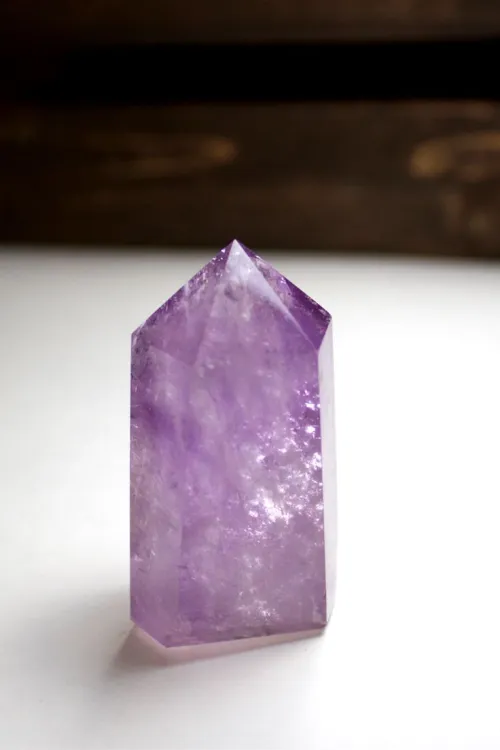
   
           
  1. Magma heats underground water to 100–250°C, creating mineral-rich brine.
  2.        
  3. Brine seeps into basalt gas bubbles or rock fractures, forming sealed "geode chambers."
  4.        
  5. Over centuries, silica precipitates layer by layer, growing hexagonal quartz crystals.
  6.        
  7. Iron impurities (10–100 ppm) infiltrate the lattice during formation.
  8.    
   

Amethyst geodes with purple crystals growing in basalt cavities


Our field observation: In Uruguayan geodes, we've seen growth zoning—alternating purple and clear layers—that mark pauses in crystal growth, like tree rings for minerals.


What Gives Amethyst Its Purple Color? The Iron-Irradiation Secret


Three elements create amethyst's signature hue:
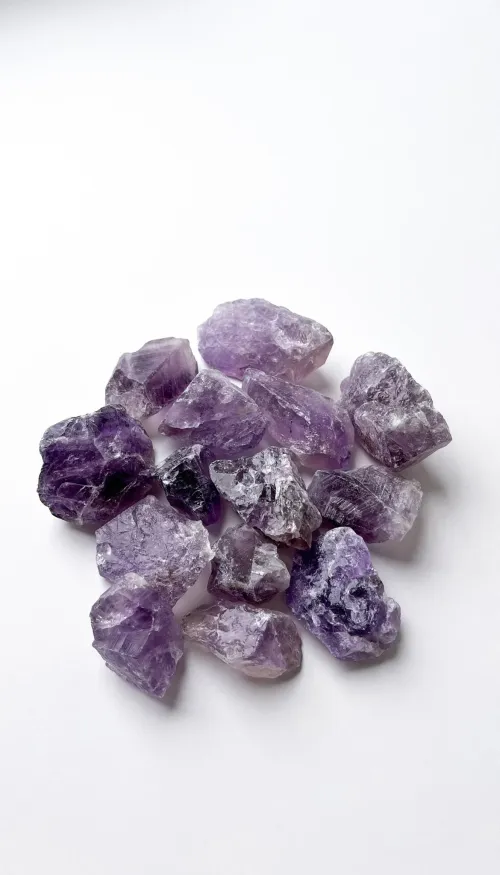
   
           
  • Iron impurities: Trace iron atoms (Fe³⁺) enter the quartz lattice during formation.
  •        
  • Natural radiation: Surrounding granite emits alpha particles (from potassium-40 decay), flipping iron to Fe⁴⁺.
  •        
  • Light interaction: Activated iron absorbs yellow-green light, reflecting violet.
  •    
   

Illustration of radiation activating iron in quartz lattice to create purple color


Regional variations exist: Siberian "Deep Russian" amethyst has higher iron (intense purple), while Brazilian crystals (hotter environments) are paler lilac. As the GIA Handbook of Gemstones notes, prolonged UV exposure can fade color over centuries—why antique amethyst jewelry sometimes turns citrine-yellow.


How to Tell If Amethyst Is Real: 5 Diagnostic Clues


Distinguishing natural amethyst from glass or synthetic quartz relies on physical properties. Below is a comparison table:

                                                                                                                                                                                                                                                                                                                               
TestNatural AmethystFake (Glass/Synthetic)
Hardness (Mohs scale)7 (scratches glass, not topaz)5–6 (scratched by steel)
FluorescenceWeak purple under UV (varies by origin)Bright green/blue (cobalt-doped glass)
InclusionsHematite needles, fluid bubbles ("healed cracks")Perfectly clear or uniform "seed" crystals
Conchoidal fracture"Rotten tooth" break with sharp edgesDull, irregular chips
Temperature feelCool to touch, warms slowlyWarms quickly (plastic) or stays cold (lead glass)
   

Pro tip: Hold a real amethyst to your lip—it feels cool initially, like a fine ceramic. Glass warms instantly.


How Scientists Date Amethyst Deposits


Since radiocarbon dating only works for organic material <60,000 years old, geologists use indirect methods:


  • Stratigraphy: Dating volcanic tuff layers above/below geodes via zircon uranium-lead decay.
  •        
  • Fossil correlation: Matching sandstone layers (e.g., Triassic fossils in Africa) to known geological timelines.
  •        
  • Paleomagnetism: Comparing rock magnetism to Earth's historical magnetic field reversals.
  •    
   

As noted in a 2021 study in Geology Today, the oldest confirmed amethyst (Brazil) dates to 280 million years ago—coinciding with the Permian Period's volcanic peak.


What Alters Amethyst's Appearance Over Time?


Even ancient amethyst changes subtly:


  • UV exposure: Fades color centers (centuries of sunlight turn it citrine).
  •        
  • Heat: Geothermal events (>300°C) can turn purple to smoky brown.
  •        
  • Radiation: Proximity to uranium deposits may deepen color (rare).
  •    
   

Our recommendation: Store amethyst away from direct sun to preserve its hue. Clean with lukewarm water only—ultrasonic cleaners risk fracturing inclusions.


Key Takeaways: Amethyst Age & Authenticity


To summarize, how old is amethyst depends on its deposit (300M–60M years), but individual crystals grow over 500k–2M years. Its purple color comes from iron activated by natural radiation (what gives amethyst its purple color), and it forms in volcanic hydrothermal chambers (how is amethyst formed). To verify authenticity (how to tell if amethyst is real), test hardness, inclusions, and fluorescence. By understanding these scientific principles, you can appreciate amethyst not just as a gem, but as a record of Earth's ancient geology.

Cart
Amethyst: The Ultimate Guide to Color, Value, Meaning & Uses
Your cart is currently empty.