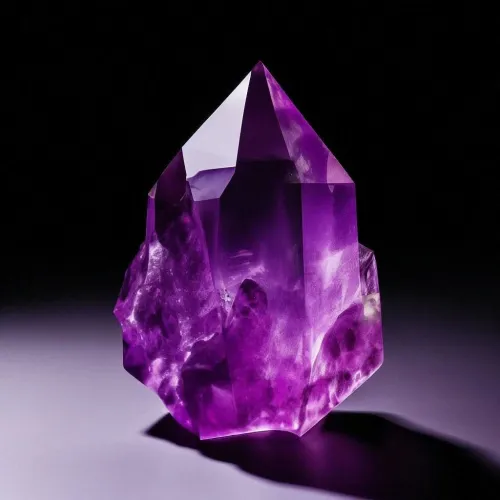
Picture this: You've carefully unpacked your cherished amethyst specimens and vintage ornaments, ready to transform your evergreen into a geological wonderland. But suddenly, hesitation hits—how do you ensure these irreplaceable crystals stay secure when little hands brush past? What about fading from holiday lights or the persistent dust settling on velvet-purple points? This uncertainty transforms holiday decorating from joy into anxiety. Here we'll navigate the practical artistry of integrating earthly treasures into seasonal celebrations, addressing everything from optimal placement physics to attachment materials that won’t harm your crystals. We'll explore how to showcase their beauty while honoring their physical limits.
Fundamental considerations for safe crystal display
Physical properties influencing display methods
Materials suitable for secure attachment
Placement strategies for visual harmony
Environmental factors affecting preservation
Cultural significance and aesthetic contexts
Common challenges and their solutions
That moment you lift a beloved amethyst cluster toward the tree, considering its security among swaying branches, demands practical reverence. Decorators balancing holiday sparkle with crystal preservation face three non-negotiable priorities.
The crystalline structure of amethyst may develop surface fissures over time, meaning attachment methods should avoid pressure on visibly delicate areas. Consider placement weight holistically; even moderate-sized specimens can cause branch drooping when grouped, much like placing multiple heavy ornaments on one limb. Before decorating, gently test branch flexibility—trees in warmer rooms with lower humidity tend to have drier, more brittle wood.
When nestled among pine needles, that rich purple hue seems almost alive—until sunlight hits it wrong. Understanding quartz's physical behavior transforms ordinary decorating into intentional preservation.
Rating 7 on the Mohs scale gives amethyst moderate durability, but its crystalline structure can fracture upon impact, particularly when suspended freely. Direct lighting introduces dual concerns: incandescent bulbs generate drying heat that may encourage microfractures, while prolonged sun exposure tends to fade that prized violet saturation. Crystal shape directly dictates display approach; irregular clusters or long points require stabilization different from tumbled stones. Darker specimens absorb more light energy than pale varieties, an invisible factor influencing placement near heat sources.
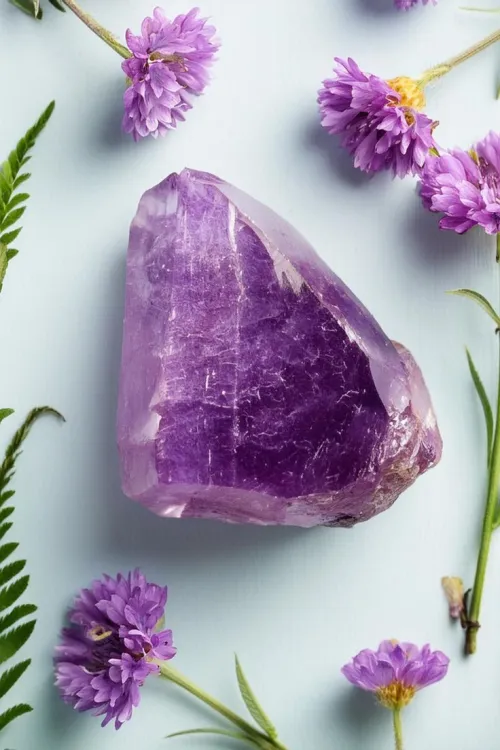
Nothing quiets holiday stress like knowing your treasures won't tumble. Selecting connection materials requires understanding both crystal vulnerabilities and evergreen realities.
Metals chosen for wrapping should either resist oxidation or be completely coated to prevent mineral interaction. Thin copper wire develops patina that could transfer to crystal surfaces when humidity changes occur near tree lights.
For pointed specimens, velvet-lined clasps act like miniature shock absorbers, distributing pressure across broader surfaces. Consider interior padding density; overly stiff materials may still create pressure points during branch movement.
Avoid adhesives not explicitly formulated for mineral bonding, as thermal expansion differences between quartz and synthetic compounds may cause detachment or residue issues. Silk ribbons offer decorative safety since their natural fibers create minimal static friction.
Positioning crystals isn’t just physics—it’s visual poetry. Proper placement merges safety with gallery-worthy staging while preventing branch strain.
Weight distribution across multiple branches maintains tree symmetry when incorporating denser pieces. LED lights offer dual advantages: their diffused glow amplifies crystal facets without the drying heat that may hasten microfractures in concentrated areas. Implement "traffic-aware" positioning—specimens placed above eye level toward the tree’s central third region experience fewer accidental contacts from passersby. For clustered displays, anchor larger pieces on sturdier lower branches and float smaller points higher like natural mineral formations.
Your living room becomes an ephemeral geology museum each December. Recognizing invisible environmental impacts helps preserve specimens beyond the season.
Indoor heated environments may spark condensation cycles affecting crystal surfaces, particularly during day-night temperature shifts. Humidity levels consistently above 60% encourage biological growth in microscopic crevices—a consideration when trees are positioned near humidifiers or kitchens. Dust accumulation poses cumulative concerns; soft-bristle brushing maintains surface clarity without abrasion risk. Speakers vibrating nearby shelves transmit energy that may shift improperly secured displays over time. Simply rotating specimens weekly helps distribute environmental exposure evenly.
Hanging amethyst transcends decoration—it’s storytelling. These purple crystals have adorned winter celebrations since Medieval times, symbolizing clarity amid darkness.
The depth of a crystal’s color interacts uniquely with lights: facet-cut specimens create prismatic dances, while satin-finished geodes absorb and radiate color more diffusely. Balance mineral placement with negative space, treating branches like gallery walls—crowding diminishes visual impact. Consider light proximity like stage direction: backlighting creates ethereal silhouettes while front lighting amplifies internal fracturing. Pair larger pieces with foliage density to frame them like natural specimens emerging from stone.
When crystal points slide sideways despite your careful knotting, frustration mounts. Most display mishaps trace back to addressable oversights in preparation or maintenance.
Off-center specimens pull branches asymmetrically using gravity’s constant persuasion. Counterweight clusters by placing complementary pieces opposite each other around the trunk circumference.
Gently push against decorated branches daily without shaking—resistance reduction signals structural stress. Reinforce weak areas with discreet fishing line tethers anchored higher on the trunk.
Position light-vulnerable pieces primarily on the tree’s northeast side, reducing cumulative daily exposure. Cleaning requires chemical neutrality; rubbing alcohol solutions lift oils without mineral interaction when applied sparingly.
Those quiet evenings admiring tree-lit amethyst become true relaxation only when security feels accounted for. As you prep for next year’s display, tuck away this practical ritual: Before hanging any stone, run your fingers over its surfaces searching for fissures needing padded protection. Then mentally map your tree into light-exposure zones—placing each piece considering both beauty and preservation. Finally, after securing your last crystal, give branches a gentle 'weather test' shake ensuring nothing sways precariously.


$
