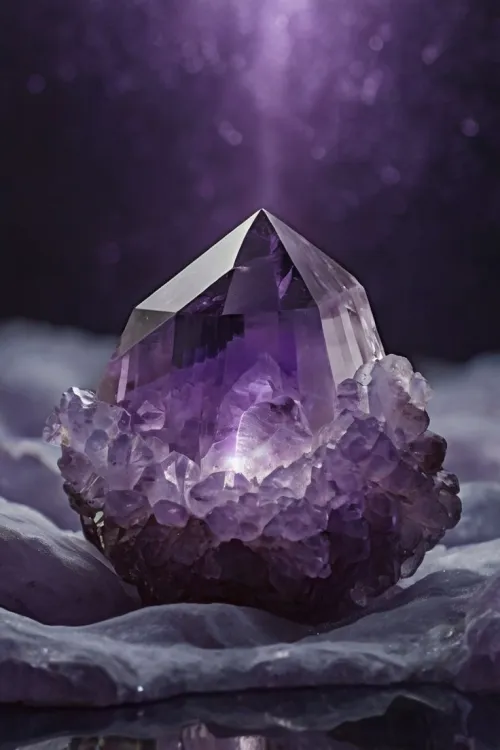
Imagine you're sitting quietly, holding a cool amethyst stone against your forehead during an evening meditation. That tingling sensation you might feel? For centuries across various traditions, people have connected this experience to the third eye—a concept representing inner vision. If you've wondered why amethyst specifically gets linked to this energy center among all crystals, or how exactly it's meant to support intuition in practical terms, you're walking a path many curious minds have explored before. Let's unwind this connection step by step, examining both the mineral's physical properties and the cultural frameworks that built this relationship. We'll look at how ancient symbolism translated into modern practices, what distinguishes amethyst from similar stones, and science-friendly ways to work with its properties.
Core foundations linking color and energy awareness
Amethyst's mineral blueprint and light interaction
Origins of chakra energy frameworks
How physical traits translate to perceived vibrations
Historical pathways bridging cultures and beliefs
Actionable techniques for mindful experimentation
Comparative qualities with related crystals
When first encountering amethyst in metaphysical contexts, many ask: Why the purple quartz? Consider yoga studios using amethyst clusters near meditation spaces—the connection often begins with color perception traditions that associate violet light wavelengths with conscious awareness transitions. Technically, a quartz variant registers 7 on the Mohs hardness scale and forms through silicon dioxide crystallization with iron impurities. This mineral base becomes visually encoded with purple—light we perceive between 380–450 nanometer wavelengths—a chromatic range culturally mapped to intuition practices worldwide.
The color zoning occurring naturally in specimens creates gradient effects. These variations can mirror the unique ways individuals experience this stone—some report heightened dream recall when placing amethyst near their bedside, while others notice subtle shifts in creative flow during daylight use. These personal responses may stem from psychological anchoring effects, where symbolic associations stimulate mindful awareness patterns.
Picture volcanic rock cavities in Brazil, where underground conditions create geodes—natural vaults lined with amethyst druzy formations. The process requires cavities in igneous rock combining with iron-rich silica solutions under specific thermal conditions, creating hexagonal crystalline structures. What makes this relevant to mind-body work? Crystalline quartz contains piezoelectric properties, meaning it generates electrical charges under mechanical stress—a trait integrated into modern technologies like watches.
In contemplative settings, practitioners may associate these responsive crystals with human bioelectrical fields. While laboratory instruments measure stone-generated microcurrents during compression, effects at skin contact remain undetectable by modern tools. Still, the psychological presence of amethyst—with its physical weight averaging 2.65 g/cm³ and crystalline transparency—can serve as tactile anchors during meditation, potentially deepening focus through sensory engagement rather than literal energy transfer.
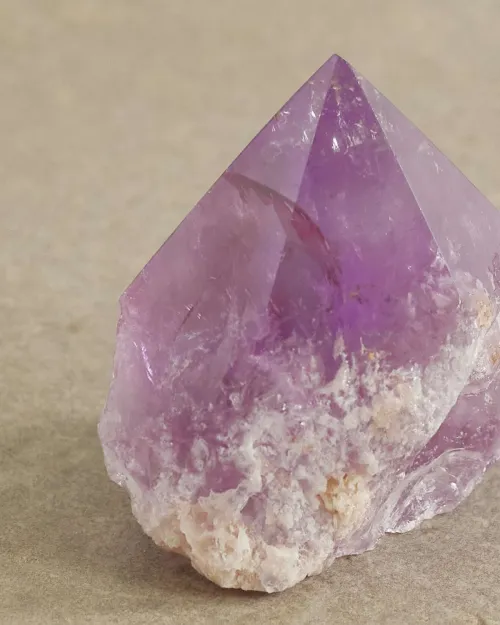
The term 'chakra' traces to ancient India's Ayurvedic and Yogic texts, describing focal points along the spine where subtle energies converge. The third eye positioning—traditionally between eyebrows—parallels neuroscience's prefrontal cortex location, governing executive functions. When practitioners place amethyst at this site during mindfulness sessions, they engage in ritualistic frameworks where symbols interact with cognitive states, potentially stimulating alpha brain waves associated with relaxed alertness.
Traditional sources indicate violet and indigo shades as corresponding to intuitive faculties within this ancient framework. These associations may stem from synaesthetic-like mappings where early contemplatives visualized internal experiences chromatically. Modern adaptations preserve these symbolic links without asserting direct physiological pathways. You might find value in positioning an amethyst between computer sessions—not as guaranteed mind-openers but as triggers for shifting mental states.
How does geological reality translate to perceptual experiences? Amethyst's violet range emerges when iron impurities absorb yellow-green light during irradiation—a sunlight sensitivity requiring darker storage to prevent hue fading. When handling specimens, notice transparency variations from translucent to near-transparent clarity, qualities that visually parallel concepts like insight clarity in meditation analogies.
Crystalline refraction creates prismatic effects under light—a phenomenon that may subconsciously influence psychological responses during reflection practices. This trait reminds us how material properties serve as metaphors: just as light bends through crystals, new perspectives may emerge through structured contemplation. Consider amethyst's hardness—it can scratch glass surfaces but remains vulnerable to harder gemstones like topaz. This resilience balance echoes mindfulness practices navigating life's complexities while protecting mental space.
Greek mythology's Dionysus legends gave amethyst its name—"a-methystos" meaning "not intoxicated"—associating the stone with sobriety focus. Monastics later used it in rosaries to sustain contemplative presence. This trajectory reveals how mineral properties became metaphorically linked with cognitive states across civilizations: Egyptians valued purple stones for dream interpretations while Byzantine royalty embedded them in crowns to signify sacred wisdom.
The historical transition to modern practice resembles how meditation techniques moved from temples to studios. Cultures including Chinese Taoist traditions and Celtic druidic practices developed parallel associations between violet stones and consciousness work—a recurring pattern suggesting symbolic resonance beyond specific dogmas. The continuity lies not in fixed interpretations but in humanity's tendency to map mineral properties onto inner experience archetypes.
How might someone experiment with these concepts today? Begin simply: place an amethyst palm stone where afternoon light hits your workspace. That brief pause when you pick it up? That's where potential effects live. The stone doesn't "activate" anything mystical—it redirects attention. Clean specimens with mild soap solutions using soft brushes, avoiding harsh chemicals. During meditation, hold cooled amethyst against your forehead not expecting revelations but observing breathing patterns shifting—that's the tangible third eye connection.
Position any quartz piece near your bedstand for a week, note dream recall variations in a journal without mystical expectations.
Place differently zoned amethysts under morning vs. evening light, observe how color gradients change—a practice connecting perception to cyclic awareness.
Other violet stones like charoite or sugilite offer texture differences—amethyst presents smoother fracture patterns and consistent vitreous luster. Unlike heat-treated citrine variants sourced from altered amethyst, naturally occurring specimens maintain uniform vibrational stability during thermal exposure tests. While lapis lazuli contains gold inclusions resembling constellations, amethyst's natural zoning patterns create landscapes-like banding, offering unique visual anchors during meditations. Such characteristics illustrate why practitioners often recommend unheated Brazilian or Uruguayan specimens—not for inherent superiority but for geological authenticity that enhances experiential intentionality.
What might these threads illuminate? The amethyst-third eye connection functions as a tactile metaphor—a physical object representing focus transitions. Try placing an amethyst near your workspace this week as a gentle reminder: when mental fog gathers, hold its cool surface while re-centering breaths. Not because it channels cosmic energies, but because conditioned anchors can trigger fresh perspectives. Notice how purple color cues in nature achieve similar effects—from twilight horizons to lavender fields triggering calm responses. That recognition of pattern-making between mineral properties and psychological states? That's our shared human "third eye" in action.
Academic mineralogy publications analyzing silicate formations
Historical anthropology texts on cross-cultural gem symbolism
Optical geology references examining light refraction in quartz


$
